
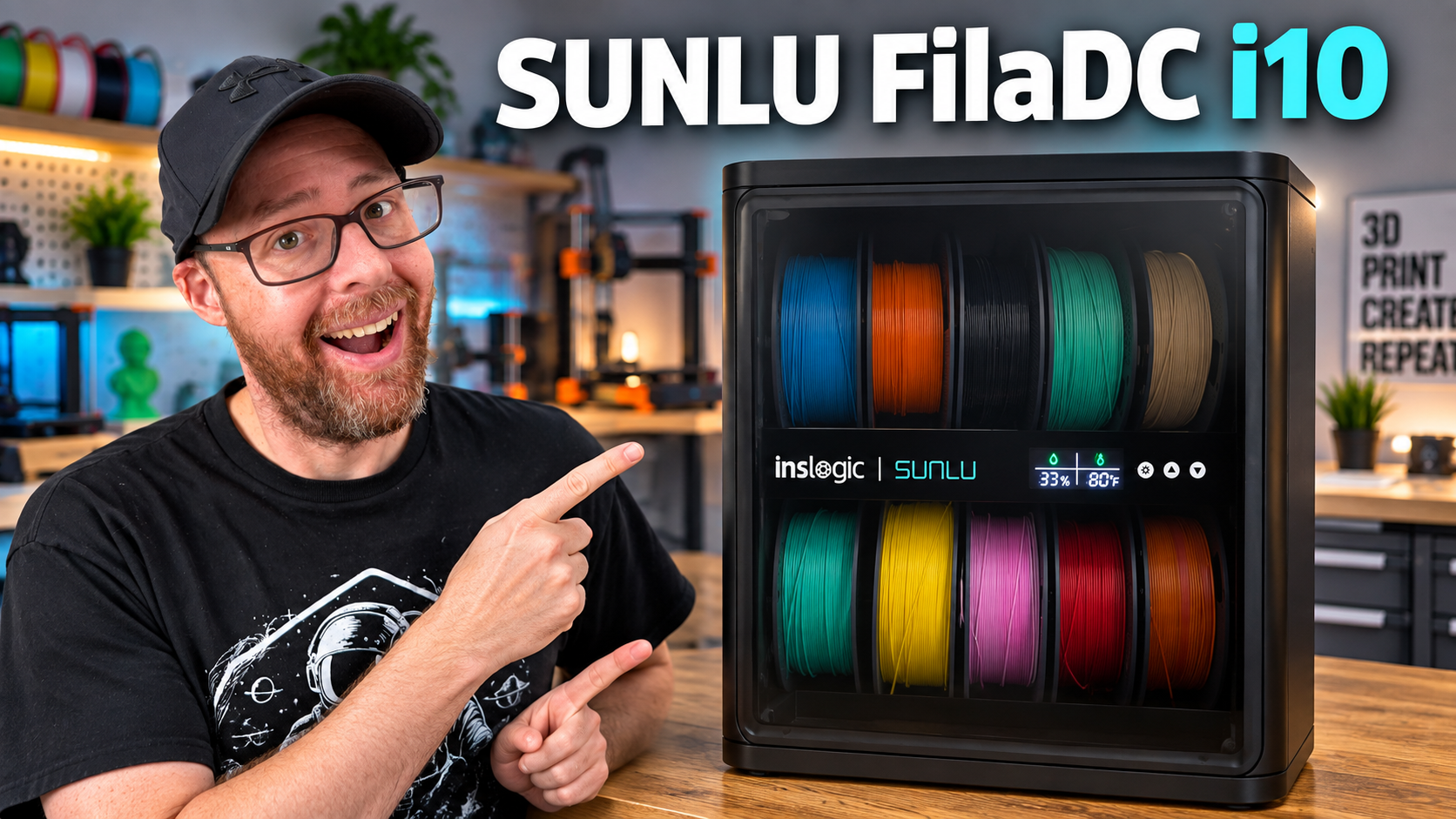
For a SUNLU FilaDC i10 review, the common tip remains. Dry your filament.
Additionally, that’s good advice, especially when you start printing with materials like PETG, as noted in SUNLU FilaDC i10 review. However, I’ve always had another problem with that whole process.
First, you dry a spool for six hours. Then you use it for a print. What happens next?
Most of us put it right back on the shelf. From there, it starts being exposed to moisture in the air again, and eventually you can end up right back where you started.
That becomes an even bigger problem when you have more than a few rolls of filament.
This is where the new SUNLU FilaDC i10 Filament Dehumidifying Cabinet comes in.
Instead of being another heated filament dryer, the FilaDC i10 is designed to store up to 10 spools of filament in a low-humidity environment so your filament stays dry and is ready when you need it.
After using it while printing a large PETG project, I think there are definitely some 3D printer owners who are going to find something like this really useful.
What Is the SUNLU FilaDC i10?
The SUNLU FilaDC i10 is a large filament storage cabinet designed specifically for keeping 3D printer filament dry.
The biggest thing to understand is that this is not a traditional heated filament dryer.
Most filament dryers use heat to remove moisture that has already been absorbed into the filament. The FilaDC i10 takes a different approach.
Its job is to maintain a low-humidity environment around filament that you want to keep dry for long-term storage.
SUNLU says the cabinet uses an automated molecular sieve dehumidification system and can maintain humidity between approximately 10% and 45% RH at room temperature.
For me, the easiest way to think about it is this:
A filament dryer fixes wet filament. The FilaDC i10 helps keep dry filament from getting wet again.
That’s an important difference.
The Real Problem With Drying Filament
If you only own two or three spools of PLA, filament storage probably isn’t a huge problem.
Once you start collecting filament, things change quickly.
I might use cyan PETG today, orange PETG tomorrow, and another color a few days later.
I don’t really want to figure out what I’m printing six hours ahead of time just so I can put the correct spool into a dryer.
I’d rather dry the filament once and then store it somewhere that keeps it dry.
That’s really the problem the FilaDC i10 is trying to solve.
Instead of having multiple small filament dryers sitting around my print room, I can keep several of my commonly used spools together and ready to go.
Why Moisture Matters With 3D Printer Filament
Not every filament reacts to moisture the same way.
PLA is pretty forgiving.
I’ve had PLA sitting around my studio for quite a while without running into major problems, especially when it has been stored reasonably well.
PETG is where I personally notice filament storage becoming more important.
PETG and other moisture-sensitive filaments can absorb water from the air. When that happens, you may start seeing problems such as:
- Excessive stringing
- Popping or crackling while printing
- Rough surface quality
- Inconsistent extrusion
- Weaker or less consistent prints
That’s why keeping filament dry matters even after you’ve already run it through a dryer.
The FilaDC i10 Holds Up to 10 Spools
One of the biggest advantages of this cabinet is simply the amount of filament you can keep inside it.
There are two storage racks, with room for approximately five standard 1 kg spools on each level.
That gives you storage for up to 10 spools of filament at once.
For somebody who regularly switches between different filament colors and materials, that is a lot more useful than drying one spool at a time.
Loading it is simple.
You open the door, place your spools on the shelves, close the cabinet, and let the dehumidification system maintain the environment inside.
I’ve been storing both PLA and PETG in mine.
My Studio Was Around 47% Humidity — The Cabinet Was at 18%
This was probably one of the most interesting things I saw while testing the SUNLU FilaDC i10.
While filming my video, the humidity inside my studio was around 47% to 48%.
We were actually having a thunderstorm at the time, so there was plenty of moisture in the air.
Inside the FilaDC i10, however, I was sitting at around 18% humidity.
I opened the cabinet to add some filament and immediately watched the humidity reading jump into the 30% range.
That makes sense because I had just opened the door and let all of that humid room air inside.
Once I closed the door, though, I could watch the humidity start coming back down.
That gave me a pretty good real-world demonstration of what the cabinet is doing.
It isn’t just a sealed plastic box.
It is actively trying to maintain the humidity level inside the cabinet.
You Can Choose Your Target Humidity
The controls on the FilaDC i10 are pretty straightforward.
The front display shows the current relative humidity inside the cabinet, and you can set the humidity level you want it to maintain.
During my testing, I set mine to 15% RH.
Since I normally have a mixture of PLA and PETG inside, that gives me a nice low-humidity storage environment for both materials.
The cabinet also displays the internal temperature.
Just remember that the temperature reading does not mean the FilaDC i10 is heating your filament.
This isn’t a heated drying chamber.
The temperature display is basically giving you another way to monitor the storage environment inside the cabinet.
You can also switch the display between Fahrenheit and Celsius.
How the Molecular Sieve Dehumidification System Works
This is one of the more interesting parts of the FilaDC i10.
A lot of us already use silica gel or desiccant beads for storing filament.
The problem is that eventually those beads become saturated with moisture.
Then you have to take them out, dry or regenerate them, put them back into your storage container, and repeat the whole process again later.
SUNLU is trying to automate that process with the FilaDC i10.
The cabinet uses a molecular sieve-based dehumidification system to remove moisture from the air inside the cabinet.
The system automatically handles the moisture it collects instead of requiring you to constantly pull out containers of desiccant and dry them yourself.
That may not sound like a huge deal at first, but when you have a lot of filament, it eliminates another little maintenance job that you would otherwise have to keep doing.
No More Desiccant Containers Everywhere
This is probably one of my favorite parts of the concept.
Over the years I’ve used filament bags, storage containers, dry boxes, desiccant packs, loose beads, and plenty of other methods to keep filament dry.
They work.
But once you have dozens of spools, you start ending up with containers and desiccant everywhere.
With something like the FilaDC i10, I can keep 10 frequently used spools in one controlled storage environment.
I don’t have to remember which silica gel needs to be regenerated or which storage box hasn’t been opened in three months.
The cabinet handles the humidity for me.
I Tested It While Printing a Large PETG Project
Watching a humidity number drop on a screen is nice, but I wanted to actually use the filament.
One of my recent projects was a large 3D printed Gotcha Pop vending machine.
Most of the machine was printed using PETG, and the entire project took me roughly a week and a half of printing on and off.
That made it a pretty good test for filament storage.
Normally, those spools would spend a lot of time sitting around my studio in between prints.
Instead, I kept the PETG inside the FilaDC i10 whenever I wasn’t using it.
When I needed a color again, I grabbed the spool, put it on the printer, and continued the project.
I didn’t have to stop and dry the spool again every time I wanted to use it.
Did Keeping the PETG Dry Make a Difference?
For this particular project, everything printed really well.
I didn’t run into moisture-related printing problems or failed prints caused by the PETG sitting around my studio.
More importantly, this project had quite a few pieces that actually needed to work together.
The vending machine includes:
- Large PETG panels
- Sliding components
- A rotating mechanism
- A coin system
- Moving internal parts
- A capsule dispensing mechanism
The finished pieces slid together properly and the mechanism worked the way it was supposed to.
Put a coin in, turn the handle, and the capsule drops out.
For a project that took more than a week to complete, having the filament stored and ready whenever I wanted to continue printing made the whole process much easier.
Does the SUNLU FilaDC i10 Replace a Filament Dryer?
No, and I don’t think that’s really what it’s supposed to do.
If you have a spool of PETG that has already absorbed a lot of moisture, I would still use a normal heated filament dryer first.
Once the filament is dry, that’s where something like the FilaDC i10 makes sense.
You can move that spool into the cabinet and keep it in a controlled, low-humidity environment until you need it again.
I actually think a filament dryer and a dehumidifying storage cabinet complement each other pretty well.
Filament dryer: Remove moisture that has already gotten into the filament.
FilaDC i10: Help prevent that filament from absorbing moisture again while it is being stored.
Who Is the SUNLU FilaDC i10 For?
I don’t think every 3D printer owner needs a 10-spool filament storage cabinet.
If you have a couple rolls of PLA and occasionally print something on the weekend, this is probably more than you need.
A smaller filament dryer combined with a sealed storage container may work perfectly fine.
The SUNLU FilaDC i10 makes much more sense for people who have a larger filament collection.
I could see it being particularly useful for:
- People with multiple 3D printers
- Etsy sellers
- Small print farms
- 3D printing content creators
- Makers who regularly use PETG
- People printing with moisture-sensitive engineering filaments
- Anyone constantly changing filament colors
- People tired of maintaining multiple dry boxes and desiccant containers
The more filament you regularly have in rotation, the more useful this type of storage system becomes.
Is a 10-Spool Filament Storage Cabinet Worth It?
That really depends on how you print.
For me, the biggest advantage isn’t that the FilaDC i10 does something completely impossible with other storage methods.
You can absolutely keep filament dry using sealed containers and desiccant.
The advantage is convenience.
Instead of managing several dry boxes, filament bags, desiccant containers, and small filament dryers, I can put several of my most commonly used spools into one cabinet.
When I need one, I open the door and grab it.
That’s it.
For someone who prints constantly, that starts becoming pretty useful.
My SUNLU FilaDC i10 Review So Far
After using it with my PETG, I think the most important thing to understand about the SUNLU FilaDC i10 is what problem it is actually solving.
It isn’t really about drying filament faster.
It’s about not having to dry the same filament over and over again.
You can dry a spool properly, put it into the cabinet, and then keep it in a controlled low-humidity environment until you need it.
For me, having up to 10 spools ready to print is much more convenient than realizing the color I need has been sitting exposed in my studio for the last month.
I still see a traditional heated filament dryer having a place in my print room.
But if I can keep filament dry after I’ve already dried it, hopefully I won’t need to use that dryer nearly as often.
And with the amount of filament I’ve collected, that’s the part of the FilaDC i10 that makes the most sense to me.
SUNLU FilaDC i10 FAQ
Is the SUNLU FilaDC i10 a filament dryer?
Not in the traditional sense. The FilaDC i10 does not use high heat to dry wet filament. It is a filament dehumidifying and storage cabinet designed to maintain a low-humidity environment and help keep filament dry during storage.
How many spools fit inside the SUNLU FilaDC i10?
The cabinet can hold up to 10 standard 1 kg filament spools, with five spools on each of its two storage levels.
Can you store PETG in the FilaDC i10?
Yes. PETG is actually one of the main reasons I like this type of system because PETG can be much more sensitive to moisture than PLA.
Can you store PLA in the FilaDC i10?
Yes. I currently keep a mixture of PLA and PETG inside mine.
Does the FilaDC i10 use heat?
The FilaDC i10 is designed to dehumidify at room temperature rather than using the high temperatures associated with traditional heated filament dryers.
What humidity can the SUNLU FilaDC i10 maintain?
According to SUNLU, the system is designed to maintain approximately 10% to 45% relative humidity, depending on the setting.
Do I still need a filament dryer?
Possibly. If your filament is already wet, I would dry it properly first. The FilaDC i10 makes the most sense as a way to keep already-dried filament dry and ready for your next print.